
I combine this cast on with the regular long tail cast on when doing knit 2, purl 2 ribbing. DnT has an animated version of the regular long tail cast on.
I first heard about this cast on in a sock knitting class and found references to it in “The Principles of Knitting” by June Hemmons Hiatt and “Latvian Dreams” by Joyce Williams.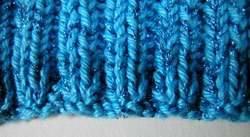
 |
Make a slip knot and place the loop on the needle. The strands are wound around the outside of the index finger and thumb. |
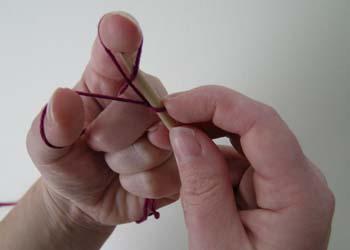 |
Pick up the strand of yarn on the far side of the index finger,
pulling it up and over the other one on the same finger and towards the first strand around the thumb. |
 |
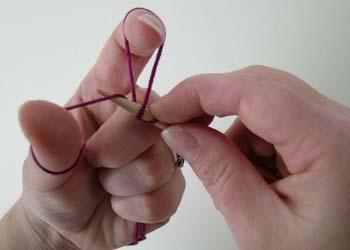
This action will make the yarn around the index finger cross, forming a loop around the index finger. |
 |
When the needle is past the first strand around the thumb, dip under it to hook it onthe needle. This strand will be looped on the needle from back to front. |
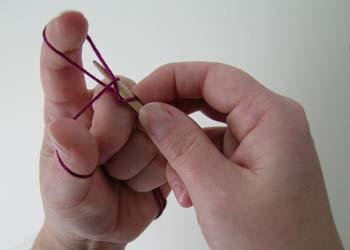 |
Pull the needle back towards the index finger slipping it between the loop around the index finger. Carefully slip the strands off the index finger and the thumb. |
 |
Tighten the stitch by tugging on the loose ends. |
 |
Flip the needle and start on the knit side. |
 Purlwise
You make this seem so clear I can’t wait to try it
LikeLike
but you do not indicate how long a tail you need in inches to cast on x number of stitches.
It always seems a a guess and lots of ripping
back before I have the tail long enough for the
number of stitches I need to cast on.
Is there some rule of x sts per inch of knitting
or stitches….ie 72 sts for a sock..how long a
tail using fingering/sock yarn.
Ninon.
LikeLike
Ninon,
That’s a good question.
I usually don’t calculate it and don’t worry about having a long tail.
Now that I think about it, it would probably be very easy to figure it out. Here’s what I was thinking.
1. Cast-on 10 stitches.
2. Mark the running thread where the cast-on ended. Perhaps by pinching the yarn with two fingers of one hand.
3. Unravel the stitches.
4. Measure the unraveled yarn from the end to the marker (in step 2).
5. Divided the number of needed stitches by 10 and multiply this number by the length of yarn found in step 4.
Suppose a cast-on with 10 stitches produces a length of yarn measuring 12 inches. If you need to cast on 70 stitches, multiply 12 by 7 to figure out that you’ll need 84 inches of yarn, plus about six inches for a tail.
LikeLike
Actually, this is my favorite cast-on result. I do it differently, not using the thumb-and-finger configuration. I simply knit and purl off of my thumb, making the stitches I need. I learned it years and years ago (at least 40), and it was called “Casting on in Pattern Stitch.” It works for everything, unless you need a provisional or invisible cast on.
mem
LikeLike
Thank you SO much for this awesome explanation!!!!! I’ve been looking everywhere for a good description of how to do the purl long tail cast on, but they were all different and extremely difficult to understand. I was getting really frustrated and was about to give up, but I came across your site, tried it, and got it on the first try!! Now I’m going to use this to make a nice 2×2 ribbed red scarf for Christmas. Thanks again!
Remy
LikeLike
Thanks for the great pictures and explanation!
LikeLike
Thanks for the clear pictures. I finally got it!
LikeLike
Thank you for a super-clear explanation of a lovely technique. I love that kind of finesse. I’m casting on for a cable scarf and wanted to have the purls look like purls and the knits look like knits — right to the bottom edge. And now I can! 🙂
LikeLike